7.1 Orthogonal Vectors and Orthogonal Matrices
Introduction
On a map, north and east are completely independent directions. Moving north does not change your east coordinate at all. This orthogonal coordinate system is what makes map reading, GPS calculations, and building design so straightforward. In much the same way, a coordinate system built from mutually perpendicular vectors dramatically simplifies computation in linear algebra.
This idea is formalized through orthogonal vectors and orthogonal matrices. Far from being mere mathematical abstractions, orthogonal matrices are the backbone of rotation transforms in computer graphics, Fourier transforms in signal processing, and unitary transforms in quantum mechanics. Orthogonality is also a key property that guarantees numerical stability in scientific computing.
Orthogonal Vectors
Definition: Zero Inner Product
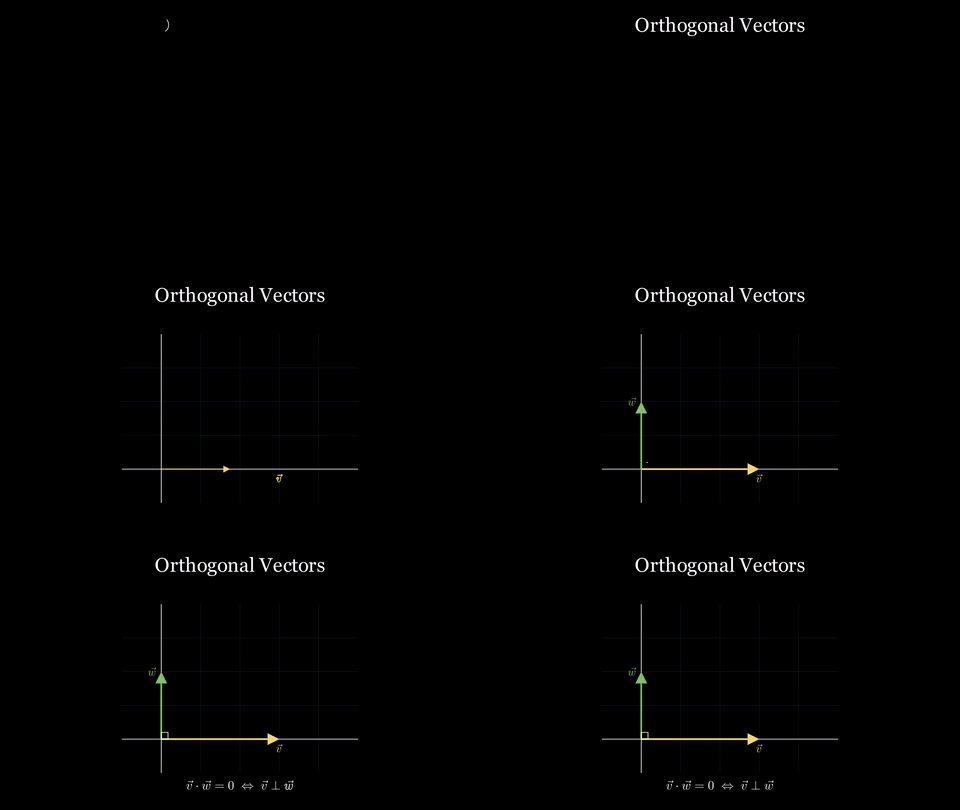
Two vectors $\vec{u}$ and $\vec{v}$ are orthogonal if their inner product (dot product) is zero:
\[\vec{u} \cdot \vec{v} = \vec{u}^T\vec{v} = \sum_{i=1}^{n} u_i v_i = 0\]Geometrically, this means the two vectors meet at a 90-degree angle (assuming both are nonzero).
Example
\[\vec{u} = \begin{pmatrix}1\\2\\3\end{pmatrix}, \quad \vec{v} = \begin{pmatrix}1\\1\\-1\end{pmatrix}\] \[\vec{u} \cdot \vec{v} = (1)(1) + (2)(1) + (3)(-1) = 1 + 2 - 3 = 0 \checkmark\]So $\vec{u}$ and $\vec{v}$ are orthogonal.
The Pythagorean Theorem Generalized
The Pythagorean theorem extends naturally to orthogonal vectors:
\[\|\vec{u} + \vec{v}\|^2 = \|\vec{u}\|^2 + \|\vec{v}\|^2 \quad (\text{when } \vec{u} \perp \vec{v})\]Proof:
\[\|\vec{u} + \vec{v}\|^2 = (\vec{u}+\vec{v})\cdot(\vec{u}+\vec{v}) = \|\vec{u}\|^2 + 2\underbrace{\vec{u}\cdot\vec{v}}_{=0} + \|\vec{v}\|^2 = \|\vec{u}\|^2 + \|\vec{v}\|^2\]Orthonormal Sets
Orthogonal + Unit Length
A set of vectors ${\vec{u}_1, \vec{u}_2, \ldots, \vec{u}_k}$ is called orthonormal if it satisfies two conditions:
- Orthogonality: $\vec{u}_i \cdot \vec{u}_j = 0$ whenever $i \neq j$
- Normalization: $|\vec{u}_i| = 1$ for every $i$
These two conditions can be written compactly as:
\[\vec{u}_i \cdot \vec{u}_j = \delta_{ij} = \begin{cases} 1 & (i = j) \\ 0 & (i \neq j) \end{cases}\]where $\delta_{ij}$ is the Kronecker delta.
Orthogonal Sets Are Linearly Independent
Any orthogonal set (that does not contain the zero vector) is automatically linearly independent. This is what makes orthonormal bases so convenient for representing coordinates.
Proof sketch: Suppose $c_1\vec{u}_1 + c_2\vec{u}_2 + \cdots + c_k\vec{u}_k = \vec{0}$. Taking the inner product of both sides with $\vec{u}_i$ immediately gives $c_i = 0$.
Orthogonal Matrices
Definition
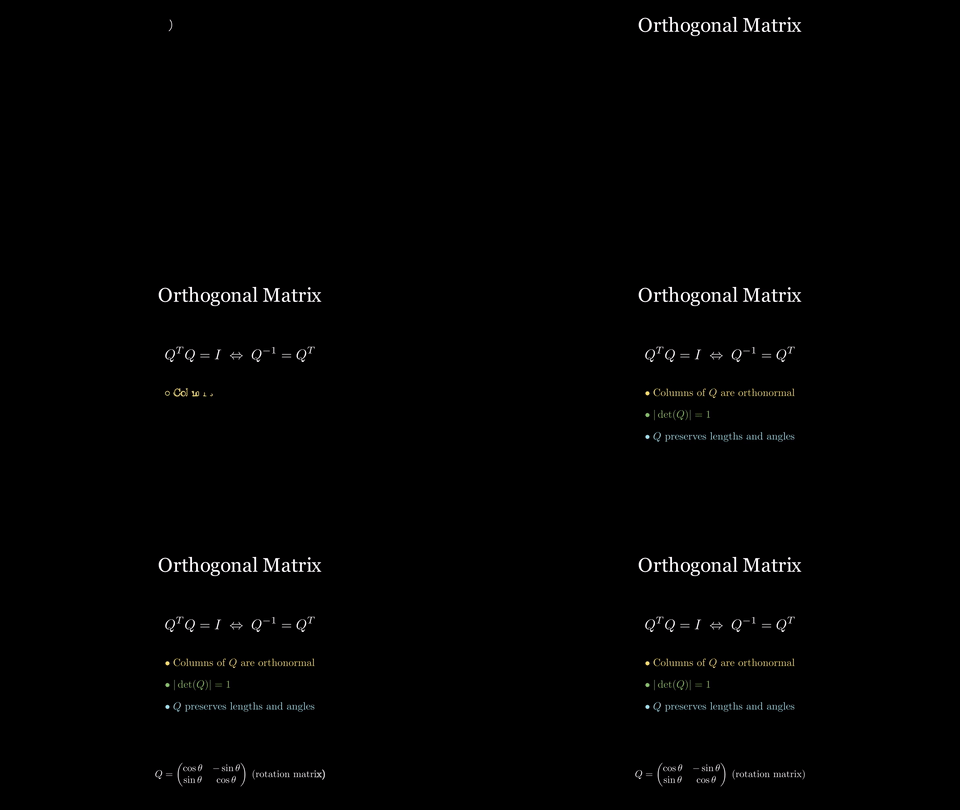
A square matrix $Q$ is an orthogonal matrix if:
\[Q^T Q = Q Q^T = I\]In other words, the inverse of $Q$ is simply its transpose:
\[Q^{-1} = Q^T\]The columns of an orthogonal matrix form an orthonormal set, and so do its rows.
Key Properties of Orthogonal Matrices
Length preservation:
\[\|Q\vec{x}\| = \|\vec{x}\| \quad \text{for all } \vec{x}\]Proof:
\[\|Q\vec{x}\|^2 = (Q\vec{x})^T(Q\vec{x}) = \vec{x}^T Q^T Q \vec{x} = \vec{x}^T I \vec{x} = \|\vec{x}\|^2\]Angle preservation:
\[\cos\theta = \frac{(Q\vec{x}) \cdot (Q\vec{y})}{\|Q\vec{x}\|\|Q\vec{y}\|} = \frac{\vec{x}^TQ^TQ\vec{y}}{\|\vec{x}\|\|\vec{y}\|} = \frac{\vec{x}\cdot\vec{y}}{\|\vec{x}\|\|\vec{y}\|}\]In other words, an orthogonal matrix is an isometry – it preserves the shape and size of geometric objects.
Determinant:
\[\det(Q) = \pm 1\]When $\det(Q) = 1$, the matrix represents a pure rotation. When $\det(Q) = -1$, it includes a reflection.
Example: 2D Rotation Matrix
The matrix representing rotation by angle $\theta$:
\[Q = \begin{pmatrix} \cos\theta & -\sin\theta \\ \sin\theta & \cos\theta \end{pmatrix}\]Verifying it is orthogonal:
\[Q^T Q = \begin{pmatrix} \cos\theta & \sin\theta \\ -\sin\theta & \cos\theta \end{pmatrix} \begin{pmatrix} \cos\theta & -\sin\theta \\ \sin\theta & \cos\theta \end{pmatrix}\] \[= \begin{pmatrix} \cos^2\theta + \sin^2\theta & 0 \\ 0 & \sin^2\theta + \cos^2\theta \end{pmatrix} = \begin{pmatrix} 1 & 0 \\ 0 & 1 \end{pmatrix} = I \checkmark\]$\det(Q) = \cos^2\theta + \sin^2\theta = 1$ (a pure rotation, as expected).
Column Conditions for Orthogonal Matrices
Writing $Q = [\vec{q}_1 \; \vec{q}_2 \; \cdots \; \vec{q}_n]$, the condition $Q^TQ = I$ is equivalent to:
\[\vec{q}_i^T \vec{q}_j = \delta_{ij}\]That is, the columns form an orthonormal set.
Summary
| Concept | Formula / Description |
|---|---|
| Orthogonal vectors | $\vec{u} \cdot \vec{v} = 0$ |
| Orthonormal set | Orthogonal + unit length: $\vec{u}i \cdot \vec{u}_j = \delta{ij}$ |
| Orthogonal matrix | $Q^T Q = Q Q^T = I$ |
| Easy inverse | $Q^{-1} = Q^T$ |
| Length preservation | $|Q\vec{x}| = |\vec{x}|$ |
| Angle preservation | Inner products are preserved |
| Determinant | $\det(Q) = \pm 1$ |
| Rotation matrix | An orthogonal matrix with $\det(Q) = 1$ |
| Column condition | Columns form an orthonormal set |
In the next post, we explore the Gram-Schmidt process, a systematic procedure for constructing an orthonormal basis from any set of linearly independent vectors.