4.3 3D Linear Transformations
Introduction
In a 3D game, a character turns their head. In an animated film, a robot arm bends at the elbow. A drone tilts in mid-air; a spacecraft adjusts its attitude along three axes. Every one of these motions is described by a 3D linear transformation.
In three dimensions, there are three independent rotation axes (x, y, z), which makes the landscape of transformations far richer than in 2D. And when you need to handle translation (moving objects from one place to another) within the same framework, you turn to homogeneous coordinates. Let us explore the world of 3D transformations.
Rotation About the x-Axis
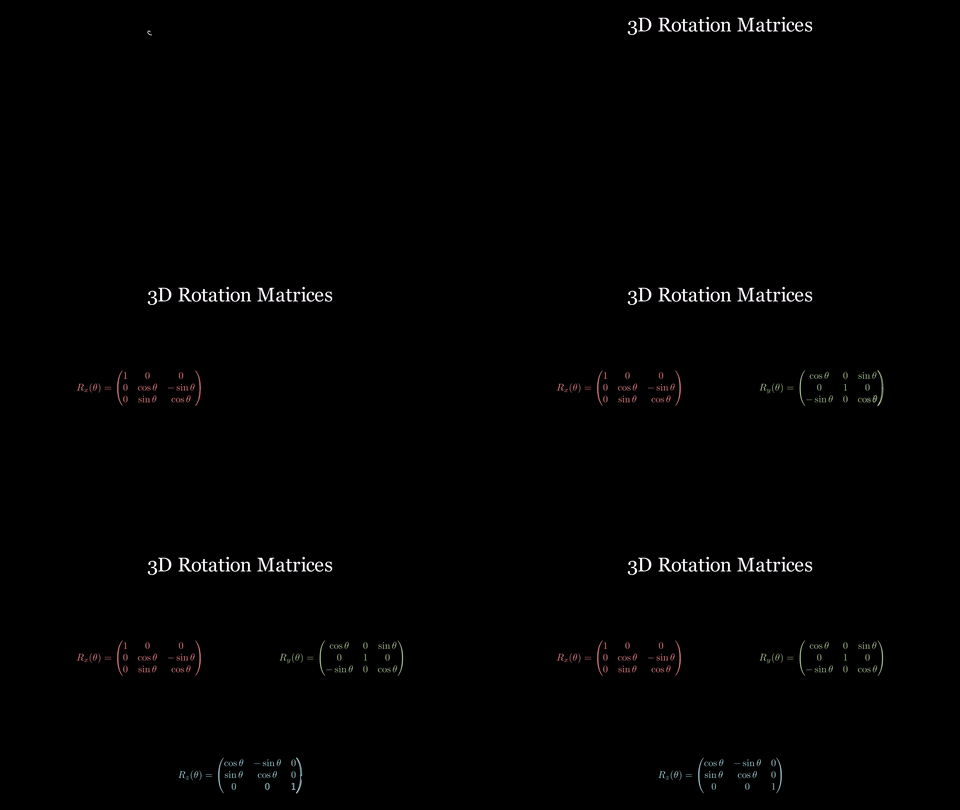
Fix the x-axis and rotate the yz-plane counterclockwise by $\theta$:
\[R_x(\theta) = \begin{pmatrix} 1 & 0 & 0 \\ 0 & \cos\theta & -\sin\theta \\ 0 & \sin\theta & \cos\theta \end{pmatrix}\]The x-coordinate stays unchanged; the y and z coordinates mix together exactly like a 2D rotation. In aviation, this is called roll – tilting the wings of an airplane.
Rotation About the y-Axis
Fix the y-axis and rotate the xz-plane by $\theta$:
\[R_y(\theta) = \begin{pmatrix} \cos\theta & 0 & \sin\theta \\ 0 & 1 & 0 \\ -\sin\theta & 0 & \cos\theta \end{pmatrix}\]Watch the signs carefully: unlike $R_x$ and $R_z$, the $\sin\theta$ terms appear in different positions. This asymmetry comes from the right-hand rule for the y-axis. In aviation terminology, this is pitch – raising or lowering the nose of the aircraft.
Rotation About the z-Axis
Fix the z-axis and rotate the xy-plane counterclockwise by $\theta$:
\[R_z(\theta) = \begin{pmatrix} \cos\theta & -\sin\theta & 0 \\ \sin\theta & \cos\theta & 0 \\ 0 & 0 & 1 \end{pmatrix}\]The upper-left $2 \times 2$ block is identical to the familiar 2D rotation matrix. The z-coordinate is left untouched. In aviation, this is yaw – turning left or right.
3D Scaling
Scale by factors of $s_x$, $s_y$, and $s_z$ along each axis:
\[S = \begin{pmatrix} s_x & 0 & 0 \\ 0 & s_y & 0 \\ 0 & 0 & s_z \end{pmatrix} = \text{diag}(s_x,\, s_y,\, s_z)\]| The volume scaling factor is $ | \det(S) | = | s_x \cdot s_y \cdot s_z | $. |

Comparing the Three Rotations
| Rotation axis | Matrix size | Fixed coordinate | Aviation term |
|---|---|---|---|
| x-axis $R_x(\theta)$ | $3\times3$ | x unchanged | Roll |
| y-axis $R_y(\theta)$ | $3\times3$ | y unchanged | Pitch |
| z-axis $R_z(\theta)$ | $3\times3$ | z unchanged | Yaw |
All three rotation matrices satisfy $\det = 1$ and $R^{-1} = R^\top$ (they are orthogonal matrices).
Homogeneous Coordinates
A linear transformation $T(\vec{x}) = A\vec{x}$ always fixes the origin. Therefore, translation – $\vec{x} \mapsto \vec{x} + \vec{t}$ – is not a linear transformation.
To work around this, we use homogeneous coordinates. Embed each 3D point $(x, y, z)$ as a 4D vector:
\[\begin{pmatrix} x \\ y \\ z \end{pmatrix} \longrightarrow \begin{pmatrix} x \\ y \\ z \\ 1 \end{pmatrix}\]Now translation can be expressed as a $4 \times 4$ matrix:
\[T_{\vec{t}} = \begin{pmatrix} 1 & 0 & 0 & t_x \\ 0 & 1 & 0 & t_y \\ 0 & 0 & 1 & t_z \\ 0 & 0 & 0 & 1 \end{pmatrix}\]With this trick, rotation, scaling, and translation can all be unified as $4 \times 4$ matrix multiplications. This is the standard approach used by graphics APIs like OpenGL and DirectX.
Key Takeaways
| Concept | Description / Formula |
|---|---|
| x-axis rotation | $R_x(\theta)$: rotates the yz-plane, Roll |
| y-axis rotation | $R_y(\theta)$: rotates the xz-plane, Pitch (watch the signs) |
| z-axis rotation | $R_z(\theta)$: rotates the xy-plane, Yaw |
| 3D scaling | $\text{diag}(s_x, s_y, s_z)$; volume scales by $|s_xs_ys_z|$ |
| Orthogonal matrices | Rotation matrices satisfy $R^{-1} = R^\top$, $\det = 1$ |
| Homogeneous coordinates | Extend 3D points to 4D; express translation as matrix multiplication |
| 4x4 translation matrix | Place the translation vector $\vec{t}$ in the last column |
In the next post, we examine composition of transformations – why the order in which you apply two transformations matters.