1.4 Magnitude and Unit Vectors
Introduction
Think about what a GPS tells you: “Your destination is 500 meters away, to the northeast.” Two pieces of information – distance (500 m) and direction (northeast) – and you need both for the navigation to be useful.
Vectors work the same way. Given a vector like $\vec{v} = (3, 4)$, we can ask two separate questions: “How long is it?” and “Which direction does it point?” The magnitude answers the first question (via the Pythagorean theorem), and the unit vector answers the second. Mastering these two concepts gives you much finer control over vectors.
Vector Magnitude (Norm)
Definition
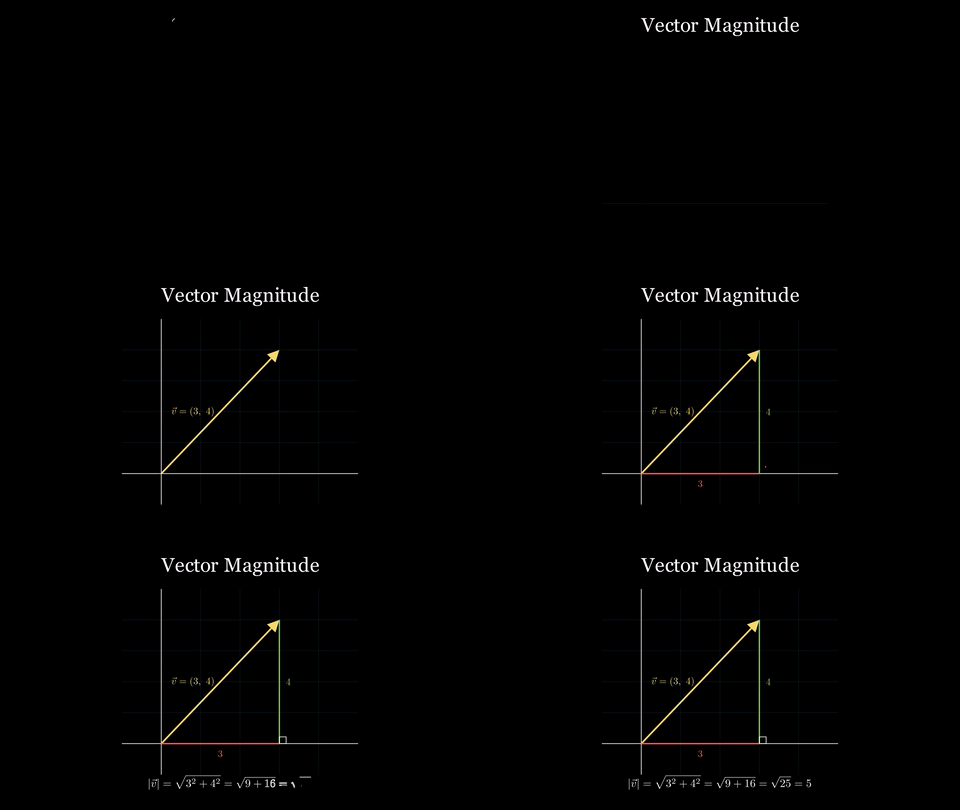
The magnitude (also called the norm or length) of a 2D vector $\vec{v} = (v_1, v_2)$ is the distance from the origin to the tip of the vector. It is computed using the Pythagorean theorem:
\[\|\vec{v}\| = \sqrt{v_1^2 + v_2^2}\]Geometrically, $v_1$ is the horizontal leg, $v_2$ is the vertical leg, and the magnitude is the hypotenuse of the right triangle they form.
Example
For $\vec{v} = (3, 4)$:
\[\|\vec{v}\| = \sqrt{3^2 + 4^2} = \sqrt{9 + 16} = \sqrt{25} = 5\]This is the classic 3-4-5 right triangle, which makes the result easy to verify by intuition.
More examples:
- $\vec{u} = (1, 1)$: $|\vec{u}| = \sqrt{1+1} = \sqrt{2} \approx 1.414$
- $\vec{w} = (-5, 0)$: $|\vec{w}| = \sqrt{25+0} = 5$
The magnitude is always non-negative. It equals zero if and only if $\vec{v} = \vec{0}$ (the zero vector).
Magnitude in 3D
For a 3D vector $\vec{v} = (v_1, v_2, v_3)$, we apply the Pythagorean theorem twice:
\[\|\vec{v}\| = \sqrt{v_1^2 + v_2^2 + v_3^2}\]Example: For $\vec{v} = (1, 2, 2)$:
\[\|\vec{v}\| = \sqrt{1^2 + 2^2 + 2^2} = \sqrt{1 + 4 + 4} = \sqrt{9} = 3\]The formula generalizes to $n$ dimensions:
\[\|\vec{v}\| = \sqrt{v_1^2 + v_2^2 + \cdots + v_n^2} = \sqrt{\sum_{i=1}^{n} v_i^2}\]Unit Vectors
Definition
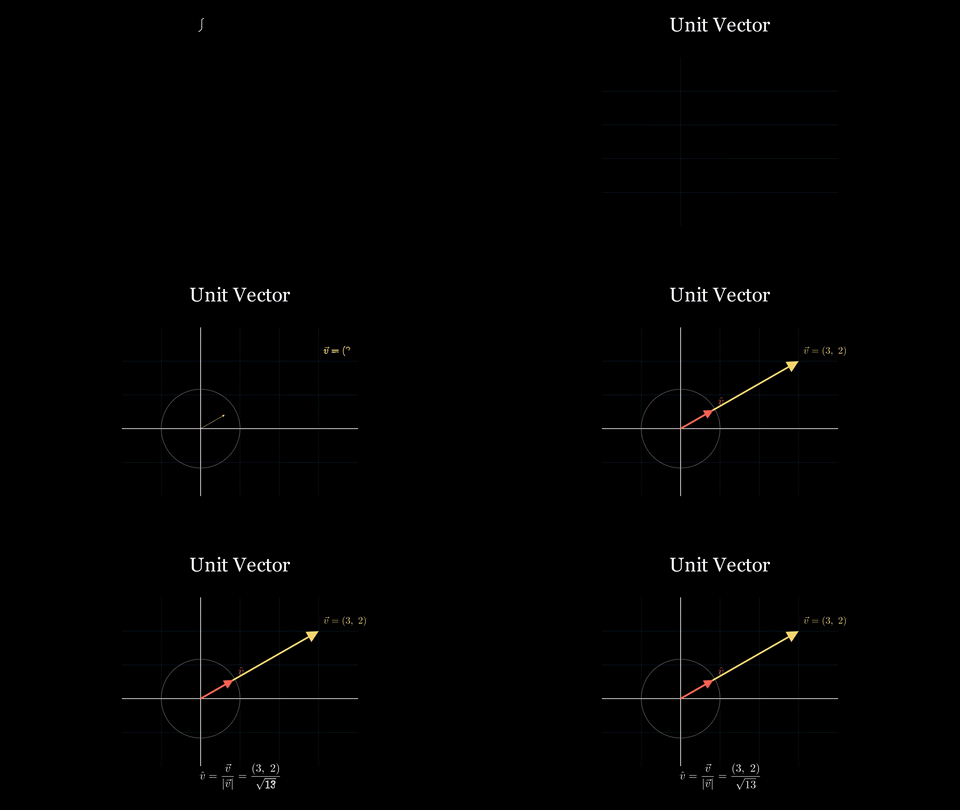
A unit vector is a vector with magnitude exactly 1. It encodes direction only, with the magnitude information stripped away.
To find the unit vector $\hat{v}$ in the direction of $\vec{v}$, divide $\vec{v}$ by its magnitude:
\[\hat{v} = \frac{\vec{v}}{\|\vec{v}\|}\]Verification: $|\hat{v}| = \left|\frac{\vec{v}}{|\vec{v}|}\right| = \frac{|\vec{v}|}{|\vec{v}|} = 1$ $\checkmark$
Example
For $\vec{v} = (3, 4)$ with $|\vec{v}| = 5$:
\[\hat{v} = \frac{(3, 4)}{5} = \left(\frac{3}{5},\ \frac{4}{5}\right) = (0.6,\ 0.8)\]Verification: $|\hat{v}| = \sqrt{0.6^2 + 0.8^2} = \sqrt{0.36 + 0.64} = \sqrt{1} = 1$ $\checkmark$
Important: The zero vector $\vec{0}$ has no unit vector, because dividing by zero is undefined.
Standard Basis Vectors
The unit vectors that point along the coordinate axes are called standard basis vectors (or standard unit vectors).
In 2D
\[\hat{i} = (1,\ 0), \qquad \hat{j} = (0,\ 1)\]- $\hat{i}$: unit vector in the positive $x$-direction
- $\hat{j}$: unit vector in the positive $y$-direction
In 3D
\[\hat{i} = (1, 0, 0), \qquad \hat{j} = (0, 1, 0), \qquad \hat{k} = (0, 0, 1)\]- $\hat{i}$: along the $x$-axis
- $\hat{j}$: along the $y$-axis
- $\hat{k}$: along the $z$-axis
Each standard basis vector has magnitude 1:
\[\|\hat{i}\| = \sqrt{1^2} = 1, \quad \|\hat{j}\| = \sqrt{1^2} = 1, \quad \|\hat{k}\| = \sqrt{1^2} = 1\]Decomposing a Vector into Magnitude and Direction
Every vector can be decomposed as the product of its magnitude and its direction:
\[\vec{v} = \|\vec{v}\| \cdot \hat{v}\]- $|\vec{v}|$: a scalar (how large the vector is)
- $\hat{v}$: a unit vector (which direction it points)
Example: For $\vec{v} = (3, 4)$:
\[\vec{v} = 5 \cdot \left(\frac{3}{5},\ \frac{4}{5}\right)\]This decomposition is used constantly in practice – in physics to separate the magnitude of a force from its direction, and in computer graphics to perform normalization.
Using the standard basis vectors, any 2D vector can also be written as:
\[\vec{v} = (v_1, v_2) = v_1\hat{i} + v_2\hat{j}\]Key Takeaways
| Concept | Description |
|---|---|
| Magnitude (2D) | $|\vec{v}| = \sqrt{v_1^2 + v_2^2}$ (Pythagorean theorem) |
| Magnitude (3D) | $|\vec{v}| = \sqrt{v_1^2 + v_2^2 + v_3^2}$ |
| Magnitude Properties | Always $|\vec{v}| \geq 0$; equals $0$ iff $\vec{v}=\vec{0}$ |
| Unit Vector | $\hat{v} = \vec{v} / |\vec{v}|$; a vector of magnitude 1 |
| Standard Basis (2D) | $\hat{i}=(1,0)$, $\hat{j}=(0,1)$ |
| Standard Basis (3D) | $\hat{i}=(1,0,0)$, $\hat{j}=(0,1,0)$, $\hat{k}=(0,0,1)$ |
| Magnitude-Direction Decomposition | $\vec{v} = |\vec{v}| \cdot \hat{v}$ |
| Classic Example | $\vec{v}=(3,4) \Rightarrow |\vec{v}|=5$, $\hat{v}=(0.6, 0.8)$ |
In the next post, we will explore the dot product – an operation that measures the angle between two vectors.