1.3 Scalar Multiplication
Introduction
Picture yourself riding a bicycle eastward at $10\text{km/h}$. If you double your speed, you are now going $20\text{km/h}$ east. If you cut your speed in half, you are going $5\text{km/h}$ east. The direction stays the same; only the magnitude changes. Now, if you slam on the brakes and reverse, you are traveling $10\text{km/h}$ west – the direction has flipped.
The operation of multiplying a vector by a scalar (a number) to stretch, shrink, or reverse it is called scalar multiplication. Together with addition, it forms the backbone of vector algebra.
Definition of Scalar Multiplication
For a scalar $c \in \mathbb{R}$ and a vector $\vec{v} = (v_1, v_2)$, scalar multiplication is defined by multiplying each component by the scalar:
\[c\vec{v} = (cv_1,\ cv_2)\]In three dimensions:
\[c\vec{v} = (cv_1,\ cv_2,\ cv_3)\]Example: For $c = 3$ and $\vec{v} = (2, -1)$:
\[3\vec{v} = (3 \cdot 2,\ 3 \cdot (-1)) = (6, -3)\]
Geometric Interpretation
Let us see how different values of $c$ transform a vector geometrically.
$c > 1$: Scaling Up (Same Direction)
\[c = 2,\quad \vec{v} = (1, 2) \Rightarrow 2\vec{v} = (2, 4)\]The direction is preserved, and the magnitude is multiplied by $c$.
$0 < c < 1$: Scaling Down (Same Direction)
\[c = \frac{1}{2},\quad \vec{v} = (4, 2) \Rightarrow \frac{1}{2}\vec{v} = (2, 1)\]The direction is preserved, and the magnitude shrinks by a factor of $c$.
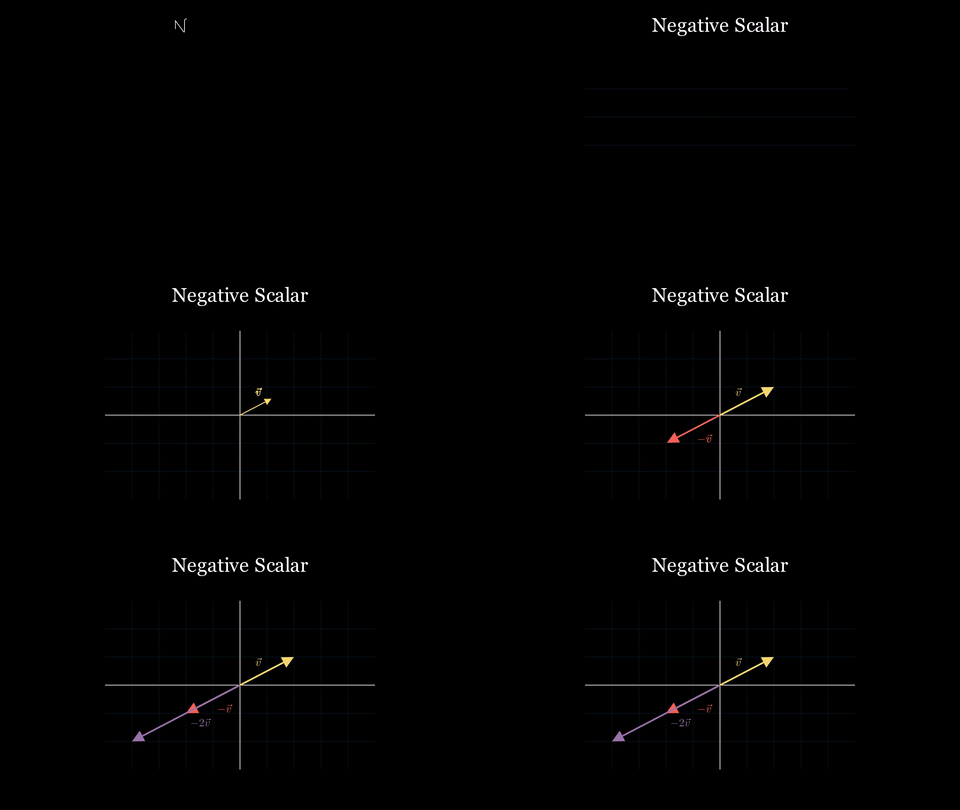
$c < 0$: Direction Reversal
\[c = -1,\quad \vec{v} = (3, 1) \Rightarrow -\vec{v} = (-3, -1)\]| The magnitude becomes $ | c | $ times the original, and the direction flips to the opposite. The special case $c = -1$ gives the additive inverse. |
$c = 0$: The Zero Vector
\[0 \cdot \vec{v} = (0, 0) = \vec{0}\]Multiplying any vector by zero collapses it to the zero vector.
Properties of Scalar Multiplication
For scalars $c, d \in \mathbb{R}$ and vectors $\vec{u}, \vec{v}$, the following properties hold.
Distributivity over Scalar Addition
\[(c + d)\vec{v} = c\vec{v} + d\vec{v}\]Example: $(2 + 3)\vec{v} = 5\vec{v} = 2\vec{v} + 3\vec{v}$
Distributivity over Vector Addition
\[c(\vec{u} + \vec{v}) = c\vec{u} + c\vec{v}\]Scalar multiplication distributes over vector addition.
Associativity
\[(cd)\vec{v} = c(d\vec{v})\]Multiplying the scalars first and then applying the product to the vector gives the same result as applying them one at a time.
Multiplicative Identity
\[1 \cdot \vec{v} = \vec{v}\]The scalar $1$ leaves the vector unchanged.
Linear Combinations
When we combine scalar multiplication with vector addition, we arrive at one of the most powerful ideas in linear algebra: the linear combination.
Given vectors $\vec{v}_1, \vec{v}_2, \ldots, \vec{v}_n$ and scalars $c_1, c_2, \ldots, c_n$, a linear combination is:
\[c_1\vec{v}_1 + c_2\vec{v}_2 + \cdots + c_n\vec{v}_n\]Example: Let $\vec{v}_1 = (1, 0)$, $\vec{v}_2 = (0, 1)$, $c_1 = 3$, $c_2 = 2$:
\[3(1, 0) + 2(0, 1) = (3, 0) + (0, 2) = (3, 2)\]Linear combinations are a central theme throughout linear algebra. The key question is always: can a given vector be expressed as a linear combination of other vectors? If so, what are the coefficients? The answers to these questions reveal the structure of vector spaces.
In particular, using the standard basis vectors $\hat{i} = (1, 0)$ and $\hat{j} = (0, 1)$, every vector in the 2D plane can be written as a linear combination:
\[\vec{v} = (v_1, v_2) = v_1\hat{i} + v_2\hat{j}\]Key Takeaways
| Concept | Description |
|---|---|
| Scalar Multiplication | $c\vec{v} = (cv_1,\ cv_2)$; multiply each component by the scalar |
| $c > 1$ | Stretches the vector (same direction) |
| $0 < c < 1$ | Shrinks the vector (same direction) |
| $c < 0$ | Reverses direction (magnitude scaled by $|c|$) |
| $c = 0$ | Produces the zero vector $\vec{0}$ |
| Distributivity (scalar) | $(c+d)\vec{v} = c\vec{v} + d\vec{v}$ |
| Distributivity (vector) | $c(\vec{u}+\vec{v}) = c\vec{u} + c\vec{v}$ |
| Associativity | $(cd)\vec{v} = c(d\vec{v})$ |
| Identity | $1 \cdot \vec{v} = \vec{v}$ |
| Linear Combination | $c_1\vec{v}_1 + c_2\vec{v}_2 + \cdots + c_n\vec{v}_n$ |
In the next post, we will study vector magnitude and unit vectors.