1.2 Vector Addition and Subtraction
Introduction
Suppose you start at an intersection and walk 3 km east, then turn and walk 4 km north. Where do you end up relative to where you started? You are 3 km east and 4 km north of your starting point. Combining those two displacements into one is exactly what vector addition does.
Vector subtraction is equally intuitive. If your friend is at position $B$ and you are at position $A$, then the relative displacement from you to your friend is $\vec{B} - \vec{A}$. The difference of two position vectors gives you the direction and distance between two points.
Vector Addition
Component-wise Addition
Given two vectors $\vec{u} = (u_1, u_2)$ and $\vec{v} = (v_1, v_2)$, their sum is computed by adding corresponding components:
\[\vec{u} + \vec{v} = (u_1 + v_1,\ u_2 + v_2)\]In three dimensions:
\[\vec{u} + \vec{v} = (u_1 + v_1,\ u_2 + v_2,\ u_3 + v_3)\]Example: For $\vec{u} = (3, 1)$ and $\vec{v} = (1, 4)$:
\[\vec{u} + \vec{v} = (3+1,\ 1+4) = (4, 5)\]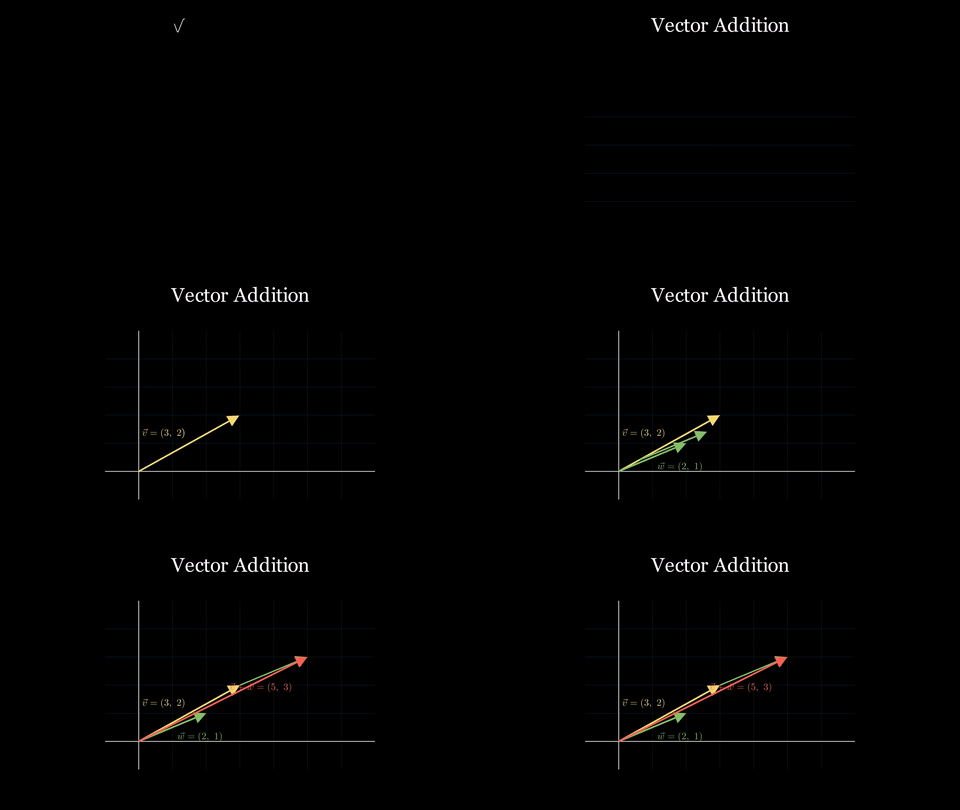
Geometric Interpretation: The Tip-to-Tail Rule
The first way to visualize vector addition is the tip-to-tail method:
- Draw $\vec{u}$ starting from any point.
- Place the tail of $\vec{v}$ at the tip of $\vec{u}$.
- The arrow from the tail of $\vec{u}$ to the tip of $\vec{v}$ is the sum $\vec{u} + \vec{v}$.
Think of it as chaining two trips together – the result is your net displacement.
Geometric Interpretation: The Parallelogram Law
The second method is the parallelogram law:
- Draw both $\vec{u}$ and $\vec{v}$ from the same starting point.
- Complete the parallelogram using the two vectors as adjacent sides.
- The diagonal of the parallelogram is $\vec{u} + \vec{v}$.
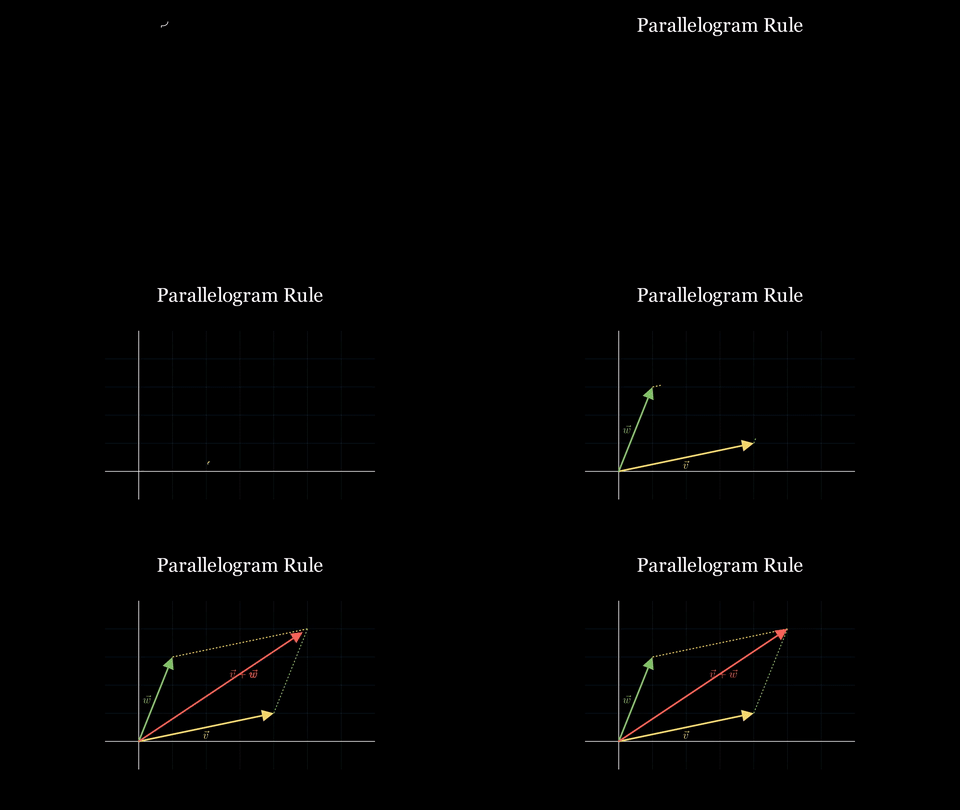
Both methods always give the same result.
Properties of Addition
For vectors $\vec{u}$, $\vec{v}$, $\vec{w}$ and the zero vector $\vec{0} = (0, 0)$, the following properties hold.
Commutativity
\[\vec{u} + \vec{v} = \vec{v} + \vec{u}\]The parallelogram picture makes this obvious: it does not matter which side you draw first – the diagonal is the same.
Associativity
\[(\vec{u} + \vec{v}) + \vec{w} = \vec{u} + (\vec{v} + \vec{w})\]The order in which you group three vectors does not affect the final sum.
Zero Vector (Additive Identity)
The zero vector $\vec{0} = (0, 0)$ is the additive identity:
\[\vec{v} + \vec{0} = \vec{0} + \vec{v} = \vec{v}\]Additive Inverse
For every vector $\vec{v} = (v_1, v_2)$, there exists an additive inverse $-\vec{v} = (-v_1, -v_2)$:
\[\vec{v} + (-\vec{v}) = \vec{0}\]The additive inverse has the same magnitude as $\vec{v}$ but points in the opposite direction.
Vector Subtraction
Definition
Vector subtraction is defined as adding the additive inverse:
\[\vec{u} - \vec{v} = \vec{u} + (-\vec{v})\]In terms of components:
\[\vec{u} - \vec{v} = (u_1 - v_1,\ u_2 - v_2)\]Example: For $\vec{u} = (5, 3)$ and $\vec{v} = (2, 1)$:
\[\vec{u} - \vec{v} = (5-2,\ 3-1) = (3, 2)\]Geometric Meaning of Subtraction
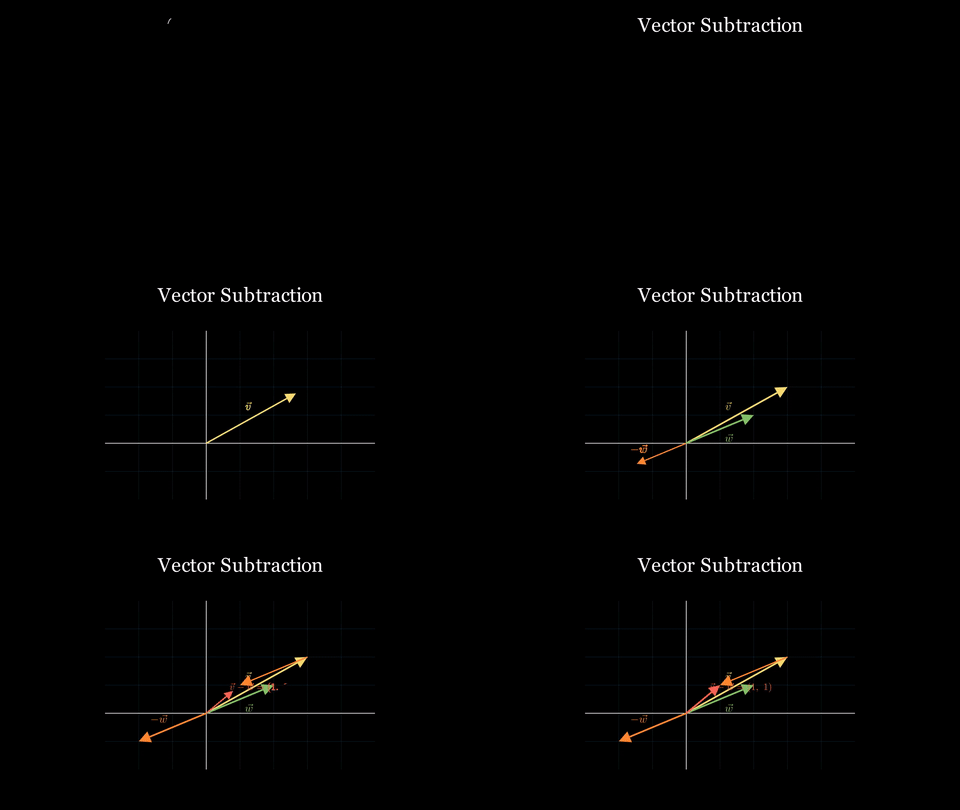
When $\vec{u}$ and $\vec{v}$ are drawn from the same starting point, the vector $\vec{u} - \vec{v}$ points from the tip of $\vec{v}$ to the tip of $\vec{u}$.
In other words, $\vec{u} - \vec{v}$ represents the relative displacement from the position of $\vec{v}$ to the position of $\vec{u}$. This is how subtraction is used to find the vector between two points.
Tip-to-tail verification: Draw $-\vec{v}$ first, then attach $\vec{u}$ at its tip – you get the same result.
Key Takeaways
| Concept | Description |
|---|---|
| Vector Addition (components) | $\vec{u} + \vec{v} = (u_1+v_1,\ u_2+v_2)$ |
| Tip-to-Tail Rule | Place the tail of $\vec{v}$ at the tip of $\vec{u}$ to find the sum |
| Parallelogram Law | The diagonal of the parallelogram formed by $\vec{u}$ and $\vec{v}$ is the sum |
| Commutativity | $\vec{u} + \vec{v} = \vec{v} + \vec{u}$ |
| Associativity | $(\vec{u}+\vec{v})+\vec{w} = \vec{u}+(\vec{v}+\vec{w})$ |
| Zero Vector | $\vec{v} + \vec{0} = \vec{v}$ |
| Additive Inverse | $\vec{v} + (-\vec{v}) = \vec{0}$; same magnitude, opposite direction |
| Vector Subtraction | $\vec{u} - \vec{v} = \vec{u} + (-\vec{v}) = (u_1-v_1,\ u_2-v_2)$ |
| Geometric Meaning of Subtraction | The vector from the tip of $\vec{v}$ to the tip of $\vec{u}$ |
In the next post, we will explore scalar multiplication.